Tour de Course
.png)
Introduction
We'd run out of new ground to discover in the Alps and the Dolomites. Every pass worth driving had been driven twice already, most of them three or four times over. We had to find something new, and after some deliberation, we settled on Corsica.
Corsica isn't really an island with mountains on it, it's a mountain that happens to have the sea around it. That's also exactly why it's been hosting the Tour de Corse since 1956, a rally so relentlessly twisty it earned the nickname the "10,000 Turns Rally," and one of the very few WRC rounds run entirely on tarmac rather than gravel or snow. It was part of the World Rally Championship from the very first season in 1973 through to 2008, and there's a local joke that the longest straight on the whole island is the runway at Ajaccio airport. None of us had even been there, reachable only by ferry, with a reputation among drivers for some of the most demanding tarmac in Europe. Getting there and back would take the better part of nine days and take in France, Italy, and Austria along the way, but that was rather the point.
Day 1: Sedan to the Auvergne
We gathered at the Kyriad in Sedan, a fairly basic budget hotel, but it did the job, just over the French side of the Belgian border and an easy meeting point for everyone converging from different directions. There was no dinner service that night either, so it was out into town hunting for food. We ended up at a Chinese place, decent enough, just not quite what any of us had been hoping for on the eve of a trip like this. None of that mattered much. The adventure was about to start.
We had a ferry to catch and a lot of ground to cover before it, but the approach never changes: no motorways, because a motorway is where driving goes to die. Even an unremarkable stretch of French country lane is a thousand times better than any stretch of Autoroute, and that's worth more than the time it costs. The route ran south through Champagne and Burgundy into the Auvergne, 610 kilometres of it, quiet D-roads doing what they do best.
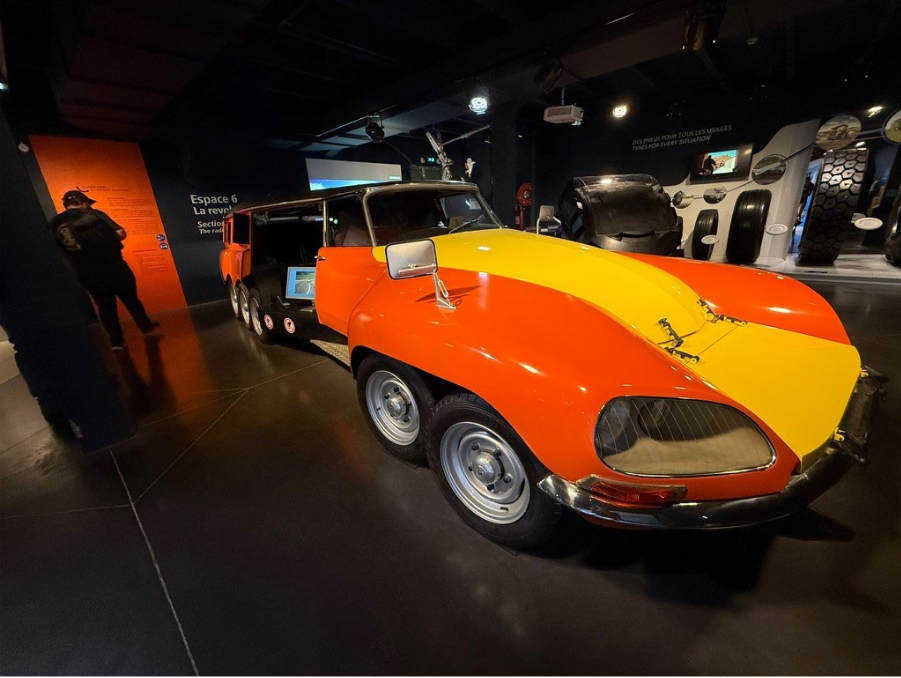
The one proper stop of the day was L'Aventure Michelin in Clermont-Ferrand, the city where the company was founded in 1889 and still headquartered today. Housed in a renovated early 20th century workshop on the old Cataroux factory site, 2,000 square metres tracing everything from the first detachable bicycle tyre in 1891 through to Michelin's years in Formula 1 between 1977 and 2001. Bibendum, the Michelin Man, got his own corner too, created in 1898 and still one of the most recognised logos anywhere.
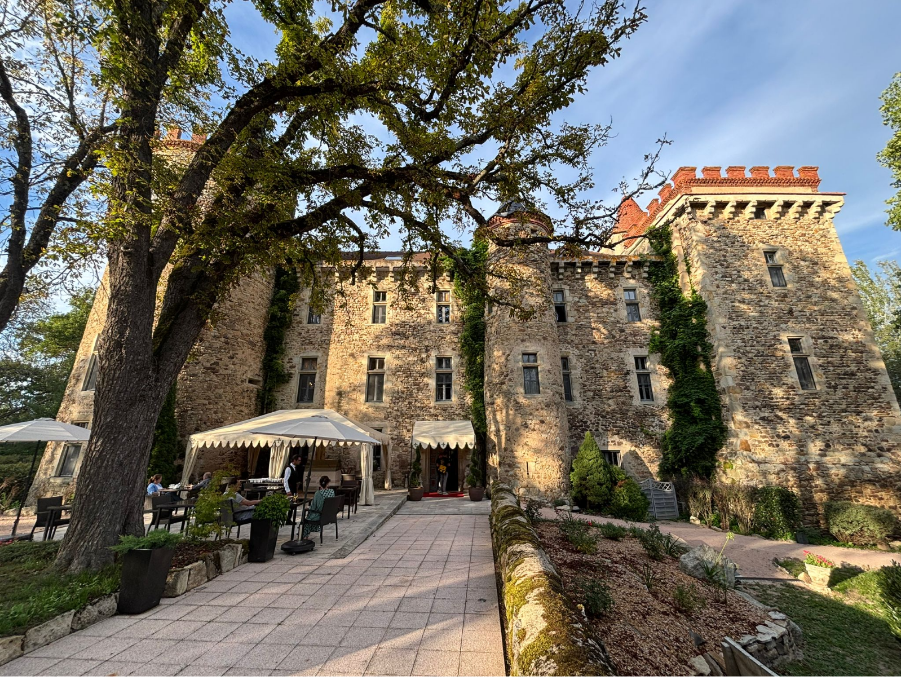
The day ended somewhere else entirely: Château de Codignat in Bort-l'Étang, a genuine 15th century castle turned Relais & Châteaux hotel, one Michelin star in the restaurant, dinner cooked by chef Mathieu Barbet. Quite the contrast with the Kyriad the night before.
Route facts: Sedan, France to Bort-l'Étang, France · 611 km · L'Aventure Michelin, Château de Codignat
Day 2: Codignat to Toulon
We left the castle behind for a second long transit day, on paper one of the best routes of the entire trip, 500 kilometres south through the Massif Central, past Issoire and down the eastern edge of the Cévennes through Langogne, Villefort, Génolhac, and Alès, before dropping through Nîmes and along the coast past Marseille and Aubagne into Provence towards Toulon. Still avoiding the motorway wherever the map allowed it, and normally that route alone would have been worth the whole day. What we didn't know leaving Bort-l'Étang that morning was that we were driving straight into one of the most violent storm systems the south of France would see all year, and we'd see precisely none of it.
It built through the day, the sky turning a bruised, greenish grey that made it obvious something serious was coming. I have never in my life driven through a downpour like that one. It never stopped, it just kept going. I kept hoping we'd outrun it eventually, but the entire day was just pouring down, mile after mile. We watched our speed all day and never once exceeded 80. My wipers were on their fastest setting, I was doing maybe 30 kilometres an hour through the worst of it, and I still couldn't see a thing. At one point I watched a car aquaplane off the road right next to me. We found out afterwards just how bad it actually was, Météo-France recorded 92.7 millimetres of rain in two hours over Toulon that evening. The Pont-du-Las district a few kilometres from where we were driving took the worst of it, streets turned into rivers, underground garages submerged, cars swept away in the current. The city was later officially declared a natural disaster zone for the flooding.
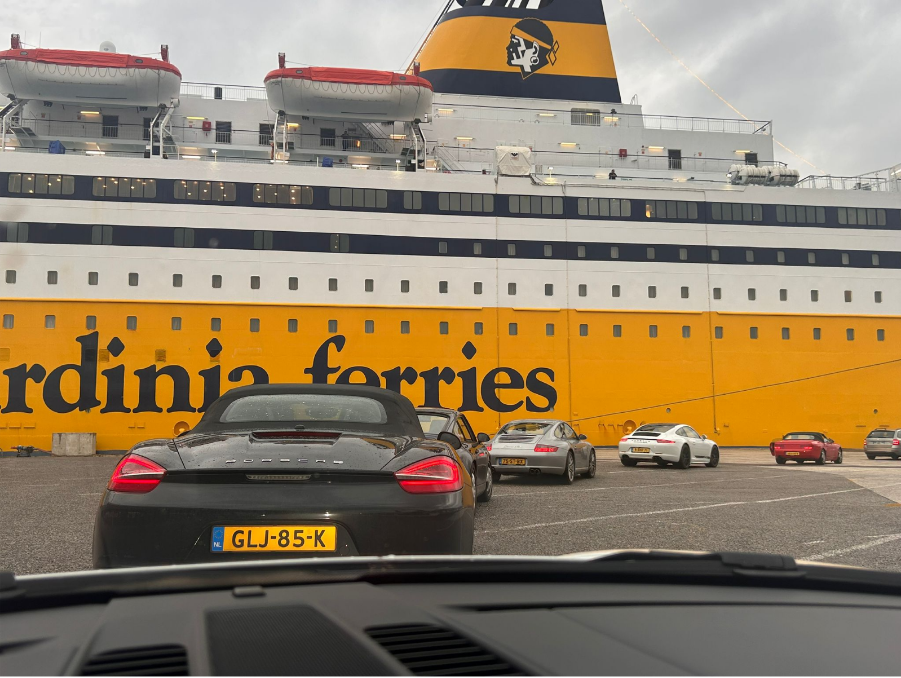
We made it to the port for our overnight ferry to Bastia, thoroughly frazzled but in one piece, and on time. The crossing itself went off without a hitch, though it was hardly the pride of the fleet and the car deck had us squeezed in nose to tail. After the day we'd had, nobody was complaining.
Route facts: Bort-l'Étang, France to Toulon, France · 503 km · Storm crossing, overnight ferry to Bastia
Day 3: Bastia to Porto-Vecchio
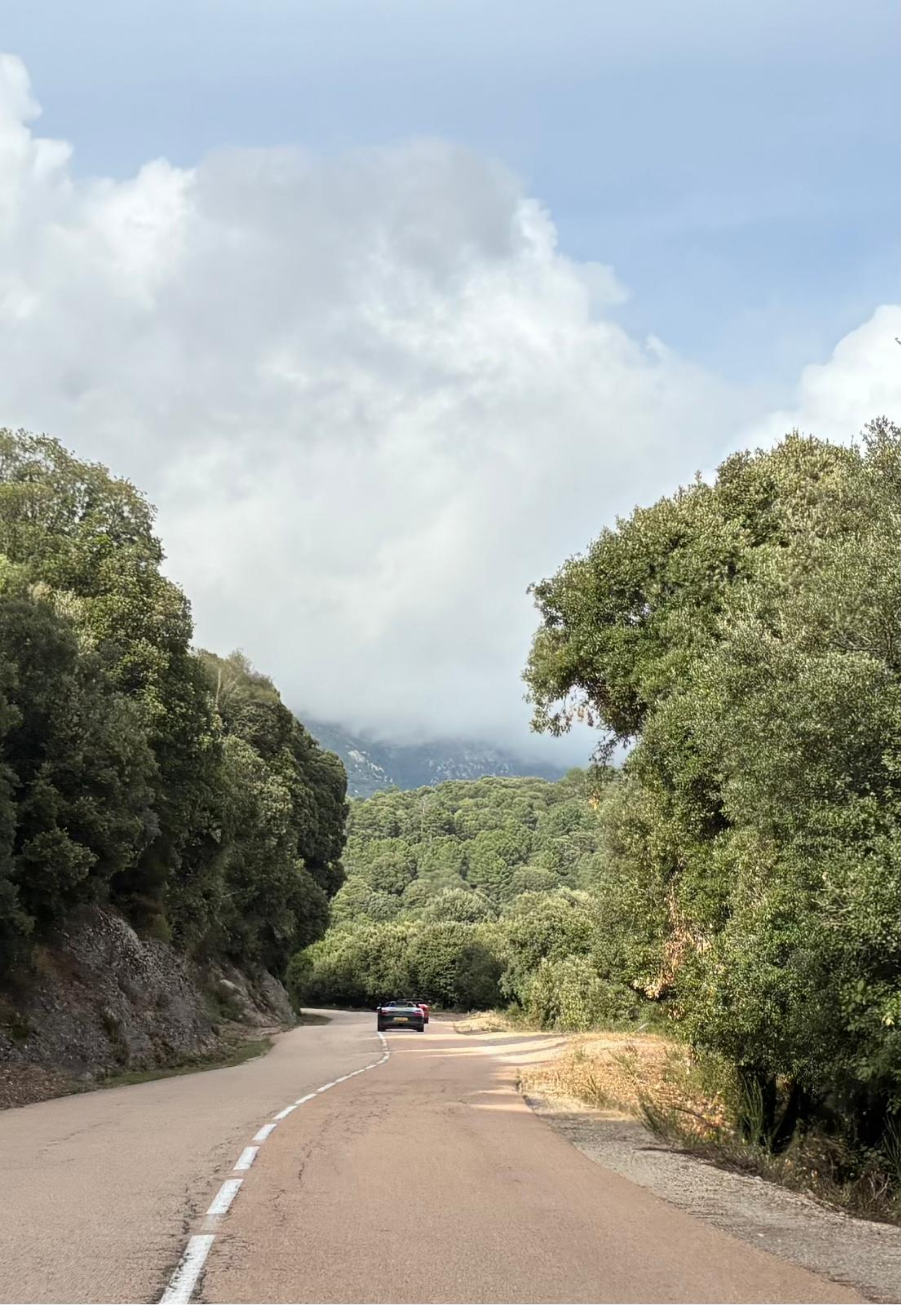
We were woken early on the ferry as it approached port, the cabin still dark, Bastia coming into view through cloud that hadn't quite decided whether to clear. Corsica wastes no time getting to the point, within a few kilometres of leaving the port the road was already climbing into the interior, and it stayed that way for most of the day.
The route strung together passes rather than towns at first. Col de Santo Stefano at 368 metres came first, a strategically important crossing between the Nebbio and the coastal plain that's seen more than one battle fought over it. Then Col de San Colombano at 692 metres, the ruins of a 13th century fortress watching over the pass from above, once the stronghold of the Marquises of Massa and Corsica.
Before Corte, a detour up the Asco Valley on the D147, one of the most dramatic drives on the island and not remotely on the way to anywhere we needed to be, which was rather the point. Thirty two kilometres each direction, narrow and unrelenting, following the river up through a gorge carved into the rock towards Monte Cinto, Corsica's highest peak at 2,706 metres. Sharp bends, high drop offs, and barely enough width in places for two cars to pass. We stopped in Asco village itself for a look at the 15th century Genoese bridge arching over startlingly emerald water, then carried on almost to Haut-Asco, the old ski station at 1,422 metres that marks the end of the road, before turning around and dropping back down to rejoin the route.
One more pass on the way into Corte: Col de San Quilico at 559 metres, the saddle that separates the Ponte-Leccia basin from the Corte basin, quieter and less dramatic than what came before but a fitting last gateway into the old capital.
The route ran inland to Corte, the old capital of Corsica, a citadel perched on a rock outcrop above the town that's served as a symbol of Corsican independence since the 18th century. From there the road climbed on to Vizzavona, at 906 metres the highest railway station on the island and the halfway point of the GR20, one of Europe's toughest long distance hiking trails, forest thick enough on either side of the road to make it feel like driving through a tunnel of green.
South of Vizzavona the road held its line straight down the island's spine, over the Col de Verde at 1,289 metres, one of Corsica's four grand cols alongside Vizzavona, Vergio, and Bavella, before continuing through the interior hills towards Zonza and dropping away east to the coast and into Porto-Vecchio. The Aiguilles de Bavella were visible off to the west for stretches of it, jagged and unmistakable, close enough to know exactly what we were missing by not turning off for them, but the day's schedule didn't allow for the detour.
Porto-Vecchio itself, where Hôtel Le Mistral gave us somewhere to finally stop and take stock. Corsica had arrived exactly as advertised.
Route facts: Bastia, Corsica to Porto-Vecchio, Corsica · 369 km · Col de Santo Stefano, Col de San Colombano, Asco Valley, Col de San Quilico, Corte, Vizzavona, Col de Verde
Day 4: Porto-Vecchio to Galeria
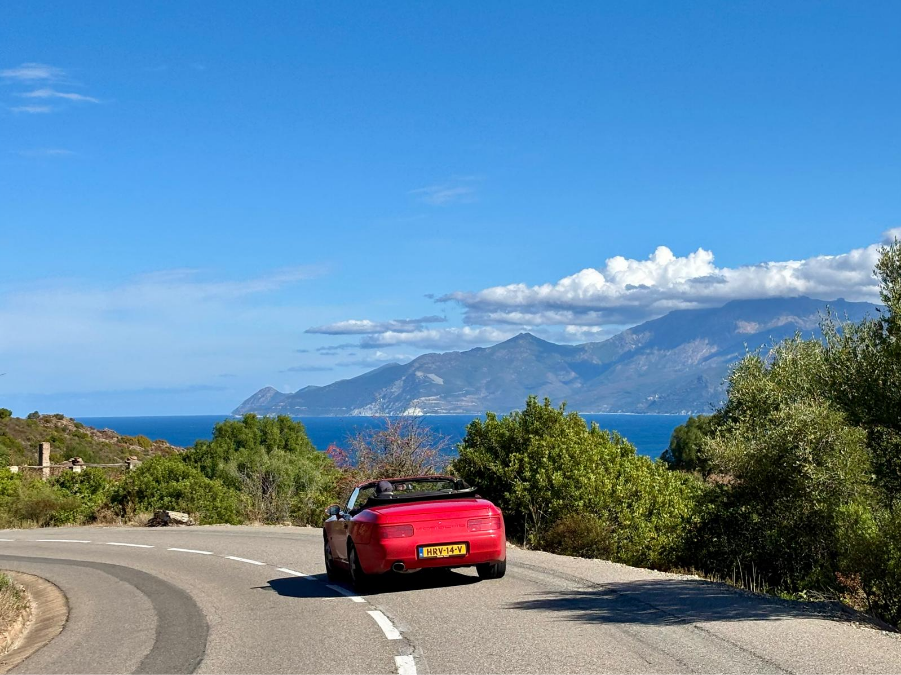
If Day 3 was about mountain passes, Day 4 was about the coast, the classic run up Corsica's west side that every driving guide puts at the top of the list. For once the reputation undersold it.
We climbed briefly through the hills above Sartène, granite houses stacked up a hillside that's barely changed in centuries, Prosper Mérimée once called it the most Corsican of Corsican towns. Down to Propriano, along the Gulf of Valinco through Olmeto, then west to Ajaccio, Napoleon's birthplace and Corsica's busiest city by a wide margin. Finding parking took the better part of forty minutes, every space already taken, and we ended up scattered across half the city, each car fending for itself before regrouping on foot. For 80,000 people it felt a lot closer to a major metropolis than expected.
North of Ajaccio the coast road runs through Cargèse, a town founded by Greek refugees in the 17th century that still has its own Greek Catholic church, before the reason everyone actually drives this way: the Calanches de Piana. Not sandstone, despite how it looks, this is red granite, magmatic rock that cooled slowly underground some 250 million years ago and has since been carved by wind and sea into spires, arches, and natural cavities rising up to 300 metres straight out of the Mediterranean. The colour shifts with the light through the day, ochre at midday, flaming red and then purple as the sun drops, iron oxide doing what a painter couldn't. UNESCO listed, and the D81 threads a narrow line through the middle of it for twelve kilometres, tight enough that you're reading the rock face as much as the road, natural arches and odd silhouettes in the stone that locals have been naming after monks, dogs, and fortresses for centuries.
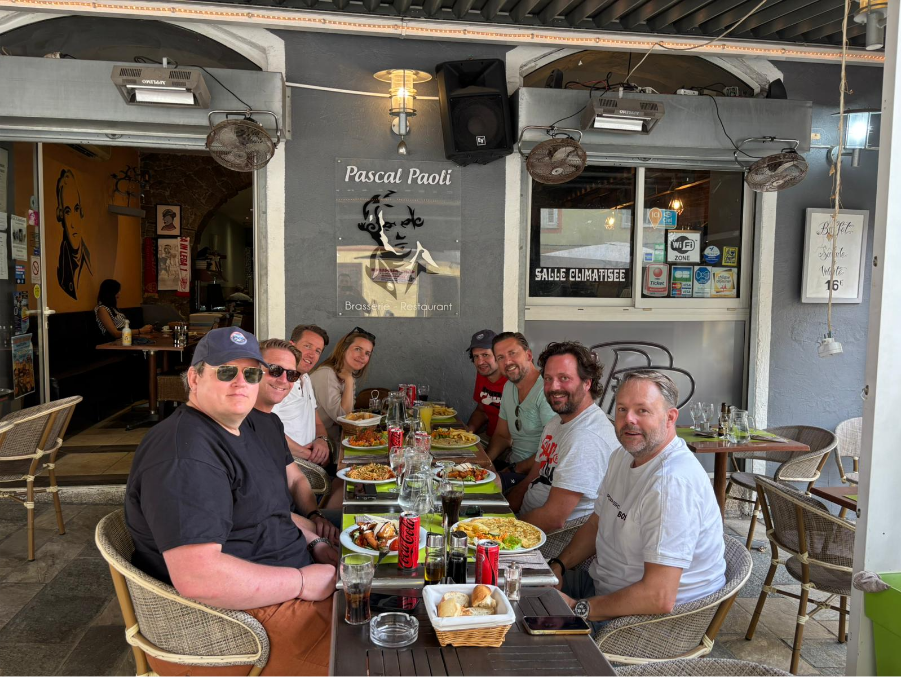
On through Porto and up to Galeria, where Hotel Cinque Arcate sits in the Fango Valley, itself a UNESCO biosphere reserve. The hotel's photos oversell it a bit, the place is showing its age, but the staff were so genuinely friendly it more than made up for it. No dinner service on site, so we walked two kilometres down the road to La Ciucciarella, and it turned out to be the find of the trip so far, proper Corsican wood fired grill, some of the best food any of us had eaten in a very long time.
Route facts: Porto-Vecchio, Corsica to Galeria, Corsica · 333 km · Sartène, Ajaccio, Cargèse, Calanches de Piana
Day 5: Galeria to Livorno
A short driving day by the standards of this trip, just over 120 kilometres before the road ran out entirely and the ferry took over, but a proper last look at Corsica before leaving it behind.
The road ran up past Calvi, its Genoese citadel perched over the bay, the birthplace, or at least the disputed birthplace, of Christopher Columbus, no solid proof either way but the town has never let that get in the way of a good story. On through the Balagne to Saint-Florent, then a last climb over the Col de Teghime at 536 metres, the only point on the whole island where you can see both coasts from the same spot, Bastia and the Tyrrhenian Sea to the east, Saint-Florent and the Agriates desert to the west. The descent ran straight through Patrimonio, Corsica's oldest and most respected wine appellation, vineyards on limestone and clay soil that's been producing serious reds, whites, and rosés since long before AOC status made it official.
Into Bastia for the ferry to Livorno, and this one had clearly seen better days, decades better by the look of it. The sea itself was calm enough, but the ship had a lean to one side that never corrected itself the entire crossing, just enough to have all of us quietly clocking the nearest emergency exit and walking the corridors at an angle. Nobody from the crew said a word about it, no announcement, no explanation, which was somehow the most unsettling part of the whole four hours.
We landed at Hotel Mediterraneo, a straightforward business hotel barely five kilometres from the ferry terminal, open since 1964 and unmistakably built for conferences rather than road trips. No dinner service, and no agreement among the group on where to go instead, there was a McDonald's directly across the road, and after the day we'd had, sacrilege or not, half the group wolfed it down without a second thought while the rest of us went looking for a proper Italian trattoria instead. Both sides came back entirely satisfied with their choice.
Route facts: Galeria, Corsica to Livorno, Italy · 124 km driving + ferry crossing · Calvi, Col de Teghime, Patrimonio
Day 6: Livorno to Ferrara
North out of Livorno, past Pisa and through Lucca, then up into the Tuscan-Emilian Apennines, the morning still wet from overnight rain. Even though we weren't pushing hard, more playing than anything else, we came round a bend to find the Carabinieri parked up by the roadside, waving us down. They were friendly enough once they'd stopped us, but firm. Neither side spoke the other's language well, but "molto pericoloso" needed no translation, delivered with a stern look that made the point better than any fine could have. Point taken, pace adjusted, we carried on.
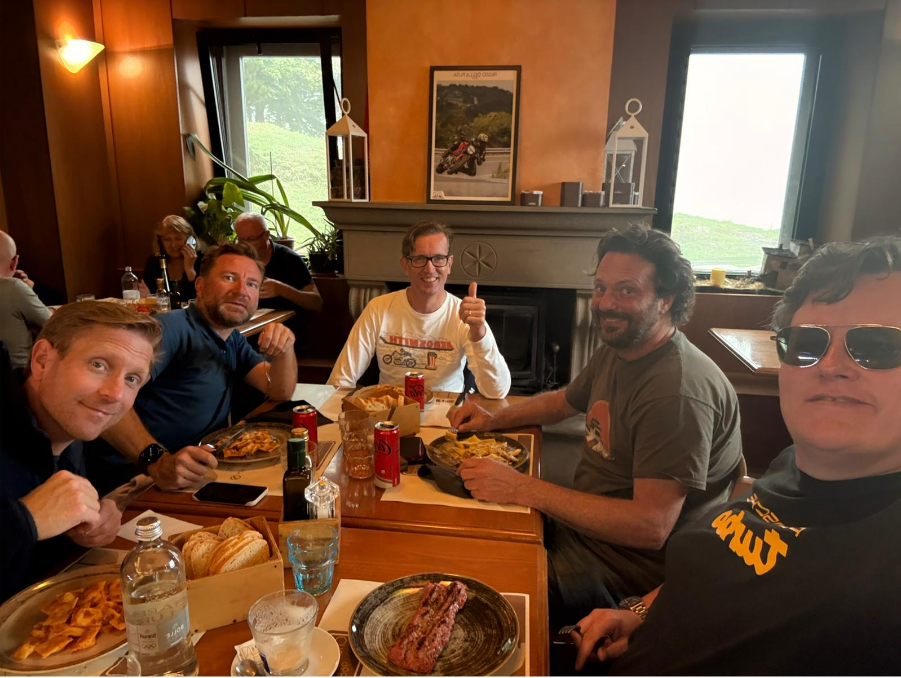
Then over the Passo della Collina and the legendary Passo della Futa at 903 metres before dropping towards Bologna. This stretch is part of the old Mille Miglia route, the same roads Enzo Ferrari and Tazio Nuvolari raced on in period, endless long sweepers tightening into hairpins as the road climbs, exactly the kind of road that makes you forget you're supposed to be somewhere later that day. At the top of the Futa we stopped for lunch at Da Jolanda in Traversa, run for sixty years now almost entirely by women, four sisters who opened it in 1964 and kept it in the family ever since, one of them, Elvira, still in the kitchen at 74. A proper institution rather than just somewhere to eat.
Full and happy, we picked the road back up and dropped down out of the mountains straight into Supercar Valley, the strip of Emilia-Romagna between Modena and Bologna that holds the highest concentration of car and motorcycle royalty anywhere on the planet: Ferrari, Lamborghini, Maserati, Pagani, Dallara, and Ducati all within a few dozen kilometres of each other. You could spend a week here and still not see it all. We had one afternoon, so we picked one name and went all in: Lamborghini.
Just outside Bologna, in Funo di Argelato, we stopped at the Museo Ferruccio Lamborghini, a private museum unrelated to the corporate one in Sant'Agata, housed in a former Lamborghini factory building. Tonino Lamborghini opened it in 2014 to tell his father's whole story, not just the cars, 9,000 square metres of tractors, helicopters, marine engines, and everything else Ferruccio ever built before he decided to take on Enzo Ferrari directly. From there a short run west to Sant'Agata Bolognese itself, the actual factory, founded in 1963 and still the only place on earth where a Lamborghini is built, the V12 Revuelto line and the newly introduced Temerario line, its twin turbo V8 hybrid having just taken over from the old naturally aspirated V10, and the MUDETEC museum next door rounding out as complete a Lamborghini history as anyone could hope to absorb in one afternoon.
The final stretch ran north to Ferrara, a UNESCO listed Renaissance city that somehow still doesn't make most people's list of Italian must sees, which is more or less exactly why it's worth the stop. Right in the middle of it sits the Castello Estense, a proper moated fortress with drawbridges and four corner towers, built in 1385 after the Este family decided they needed better protection from their own citizens after a tax revolt. It stayed the family seat for the next two centuries, and the dungeons underneath still tell some genuinely dark stories, including the beheading of a duke's wife and stepson for an affair, later reworked by Robert Browning into one of his most famous poems.
We stayed at Hotel Touring, close enough to the castle that it was the first thing visible from the room, barely 150 metres from the moat.
Route facts: Livorno, Italy to Ferrara, Italy · 289 km · Museo Ferruccio Lamborghini, Lamborghini factory (Sant'Agata Bolognese)
Day 7: Ferrara to Assling
North through the Veneto, past Rovigo and Padua, before the road properly begins climbing towards the Dolomites at Belluno. The character of the day changes entirely here, flat Po Valley farmland giving way to sheer limestone walls in what feels like a handful of kilometres.
We didn't stop at the Vajont Dam, just outside Longarone, but it's worth knowing it's there. On the night of 9 October 1963 a landslide off Monte Toc crashed into the reservoir behind it, sending a wave of water more than 200 metres high over the top of the dam and down into the valley. Longarone was almost entirely destroyed, roughly 2,000 people died in a matter of minutes, and it remains one of the deadliest man made disasters in history. The dam still stands, still empty, and it's a short, sobering detour if you're ever passing through.
From there the road pushed on through Pieve di Cadore and Auronzo, the gateway town for the Tre Cime di Lavaredo, three limestone towers that are as close to a symbol of the Dolomites as any single formation gets. We never went anywhere near them properly, that would have meant a detour west towards passes like the Gardena, but on a clear day they're visible from a genuine distance, unmistakable even as a backdrop rather than a destination. They were calling us, more or less, but Austria was waiting and the itinerary didn't have room for the detour. The route continued over the Passo di Monte Croce Comelico, through Sesto and its own valley, before crossing into Austria at Sillian and finishing the day at Assling.
We stayed at Familienhotel Moos-Alm, 1,000 metres up on the Schlossberg above Lienz, reachable by road or by the same cable car the skiers use in winter, with the Lienz Dolomites laid out across the whole view from the terrace. It's a ski hotel by history, but East Tyrol sits low enough and far enough south that reliable natural snow has become a genuine problem, and the whole mountain has quietly rebuilt itself around mountain biking instead. The same Schlossbergbahn gondola and the old chairlift that used to carry skiers now haul bikes straight up the mountain fitted with dedicated carriers, and trails named after East Tyrolean riders like Peter Sagan and Alban Lakata start right where the ski runs used to be the main draw.
Route facts: Ferrara, Italy to Assling, Austria · 324 km · Vajont Dam, Tre Cime di Lavaredo region, Passo di Monte Croce Comelico
Day 8: Assling to Breitenbach am Inn
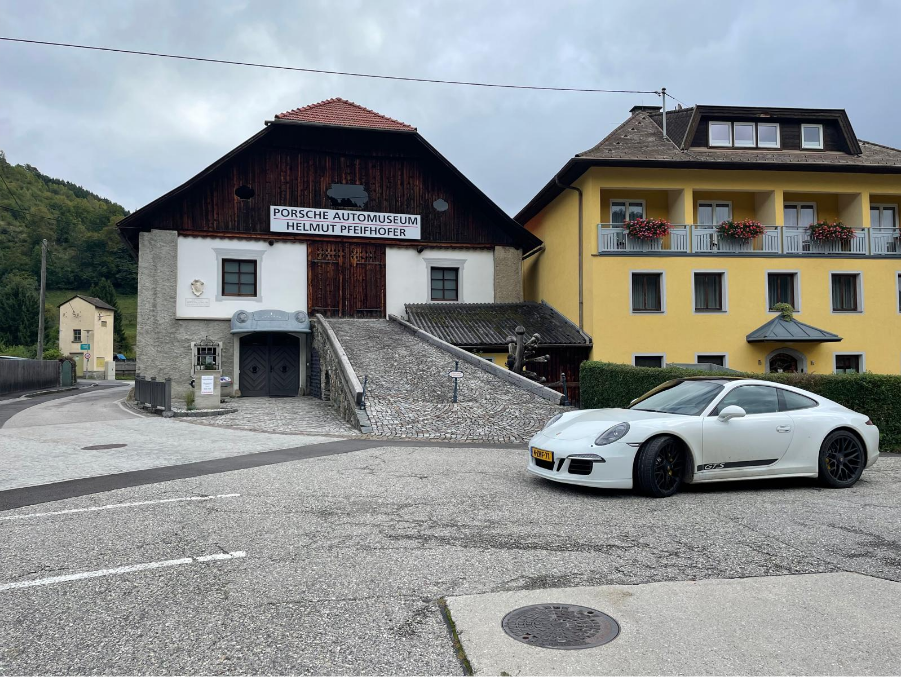
The longest day of the whole trip, 430 kilometres of it, and easily one of the most varied. Out of Assling east into Carinthia, and almost immediately a stop that had nothing to do with the day's driving plan but everything to do with why we were all there in the first place: Gmünd. This unassuming Carinthian town is where Porsche's design office relocated in 1944 after Stuttgart came under bombing, setting up in the wooden sheds of an old sawmill. It's where the very first cars to carry the Porsche name were hand built between 1944 and 1950, chassis number 356 020 among them, the eighth oldest surviving Porsche in the world. The original shed is still there, and just up the road the Porsche Automuseum Helmut Pfeifhofer holds the finest private collection of that early history anywhere, including a genuine Gmünd built 356 and Austria's only ever police spec 911.
From there a detour up the Malta valley, and this road alone would have justified the trip. 14.4 kilometres, narrow, threading through six rock tunnels blasted straight into the mountainside, waterfalls seemingly around every single corner, the whole valley genuinely earning its nickname, the Valley of the Rushing Waters. It climbs to the Kölnbrein Dam, Austria's tallest at 200 metres, sitting at nearly 1,900 metres above sea level. There's a glass floored viewing platform, the Airwalk, that hangs off the dam wall over the valley below, and we went out onto it. Genuinely stomach churning, looking straight down through your own feet at a 200 metre drop with nothing but glass in between.
Back down and north on the B99, over the Katschberg Pass at 1,641 metres, one of the very roads Ferdinand Porsche's own engineers used as a test track back when Gmünd was still their base, a nice, unplanned callback to the morning's stop. On to the Radstädter Tauern Pass at 1,738 metres, a crossing that's been in continuous use since Roman times, the Emperor Claudius having completed the first proper road over it roughly 2,000 years ago. Modern traffic mostly takes the Tauern Autobahn tunnel underneath these days, which left the old pass road refreshingly quiet, sweeping curves through the Niedere Tauern past Obertauern, one of Austria's better known ski resorts, quiet enough in September to just enjoy the road for what it is.
From there the roads settled into a long transit stretch north and west through Salzburg and into Tyrol, the day's distance finally catching up with us by the time we reached Gasthof Schopper in Breitenbach am Inn, a proper family run Gasthof with mountain views and a beer garden that did exactly what was needed after 430 kilometres.
Route facts: Assling, Austria to Breitenbach am Inn, Austria · 431 km · Gmünd (Porsche birthplace), Kölnbrein Dam, Katschberg Pass, Radstädter Tauern Pass
Day 9: Breitenbach am Inn to Home
The last day, and by far the longest, nearly 700 kilometres of it, and in hindsight far too many for a single day behind the wheel.
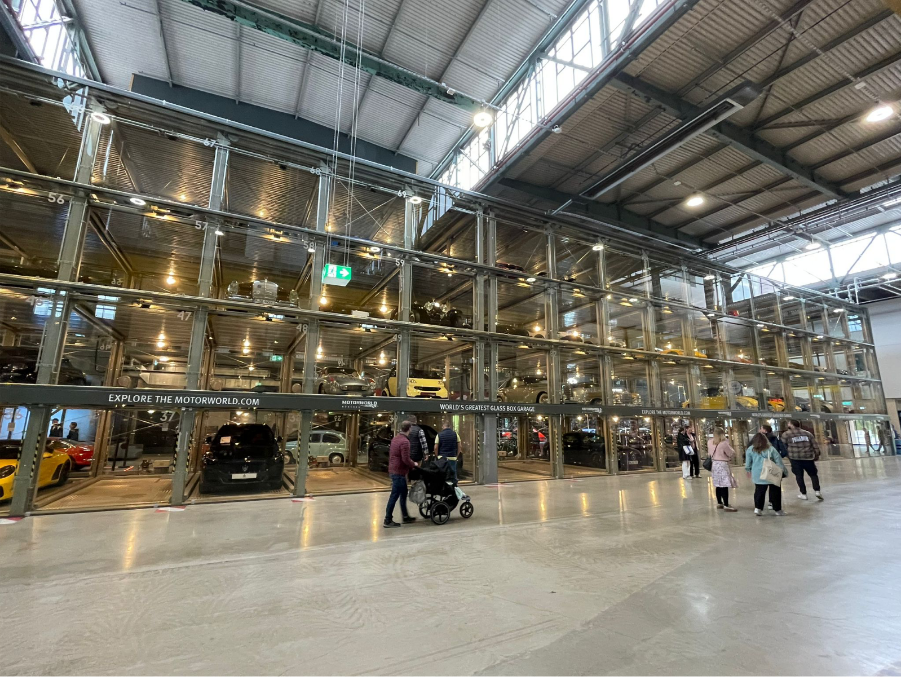
First, Motorworld München in Freimann, a former Deutsche Bahn locomotive repair hall, 185 metres long and under monument protection, converted in 2021 into 75,000 square metres of automotive everything. More than 30 of the world's most exclusive car brands under one roof, 111 glass boxes holding privately owned classics and supercars across four levels, and among the permanent exhibits, genuinely, Elvis Presley's BMW 507 and the Nissan Skyline from the Fast and the Furious films. Free entry, open every day of the year. We had lunch at one of the restaurants on site before getting back in the cars.
Then south to Stuttgart for one more stop, the Porsche Museum, a fitting last museum for a trip that had already taken in the Michelin, Ferruccio Lamborghini, and Porsche's own birthplace in Gmünd along the way.
From there it was Autobahns the entire way, Germany, then the Netherlands, right through to the centre of the country, one continuous stretch with nothing else planned in between. It's not something I would recommend. Every stop we build into a normal day, a museum, a pass, a decent lunch, exists for two reasons: it's genuinely fun, and it forces regular breaks that keep everyone sharp behind the wheel. Safety and enjoyment, same coin. Push 700 kilometres in a single day, especially the last day of a nine day trip when everyone's already tired from a week of driving adds real, unnecessary risk from fatigue exactly when the temptation is to just get it over with. We've changed how we plan the last day on every trip since.
Nine days, six countries, the worst storm any of us had ever driven through, roads we'd never forget in Corsica, and more car museums than we could properly keep track of by the end. The trip was over. But the roads never really end.
Route facts: Breitenbach am Inn, Austria to home, Netherlands · 691 km · Motorworld München, Porsche Museum Stuttgart